Marine environments destroy weak materials. Dynamic wave loads, temperature swings, and saltwater exposure demand steel that holds together under extreme stress. When you build or repair a vessel, the plate you select acts as the primary structural defense. Using the wrong grade causes catastrophic failures and severe safety hazards. Fabricators often face pressure to use readily available local structural steel instead of waiting for certified marine grades. Substituting standard steel violates the legally binding requirements of marine classification societies. It leads to rejected inspections, project delays, and denied insurance claims. A persistent debate exists across repair yards and major shipbuilding facilities regarding material substitution. You must know exactly when standard steel works and when certified marine plate is legally mandatory. This guide provides a technical evaluation framework for selecting the right marine-grade steel. We balance classification compliance, shop floor efficiency, and long-term structural integrity.
Classification is Non-Negotiable: Commercial and offshore vessels require certified materials; substituting standard structural steel without naval architect and surveyor approval introduces severe liability and compliance risks.
Grade Dictates Application: High-strength variants (like AH36) are essential for critical stress points, medium-strength grades handle moderate structural demands, while ordinary-strength grades suffice for non-critical internal components.
Fabrication Realities Impact Costs: The chosen steel grade directly influences shop workflows—dictating specific cutting methods, pre-heating requirements, welding procedures, and block assembly techniques.
Traceability is Mandatory: Procurement must secure comprehensive Mill Test Reports (MTRs) to verify chemical composition, yield strength, and impact toughness before fabrication begins.
The Critical Difference: Marine Grade vs. Standard Structural Steel
Fabrication shops frequently argue over using standard structural steel, like ASTM A36, instead of dedicated marine-grade plate. Standard structural steel costs less and sits on the racks of almost every local supplier. However, it lacks the specific metallurgical properties needed to survive ocean conditions. Using standard steel where naval architects specify marine grades compromises the entire hull.
Marine grades feature specific alloys designed to minimize impurities. Elements like sulfur and phosphorus cause brittleness in cold, dynamic environments. Steel mills use advanced manufacturing techniques, including thermo-mechanical control processing (TMCP), to achieve grain refinement. This refinement improves weldability and the inherent toughness of the steel. It ensures the plate can handle complex, multi-directional stresses without tearing.
Impact toughness separates true marine steel from standard construction materials. Charpy V-Notch testing measures the energy absorbed by the steel during fracture. Mills conduct this testing at specific temperatures, such as 0°C, -20°C, or -40°C. This guarantees the steel will not fracture under sudden dynamic stress or extreme cold. Standard A36 steel does not require this rigorous low-temperature impact testing.
Substituting standard A36 structural steel in applications requiring certified marine grades carries massive implementation risk. Legally, it violates classification society rules. This renders the vessel uninsurable and unfit for commercial operation. Structurally, it drastically increases the likelihood of fatigue cracking and hull failure under heavy sea loads. If a surveyor catches uncertified steel on the shop floor, they will force you to cut it out and replace it, destroying your project schedule.
| Steel Type | Yield Strength (Minimum) | Tensile Strength | Charpy V-Notch Testing Requirement | Typical Application |
| ASTM A36 (Standard) | 250 MPa | 400 - 550 MPa | Not typically required for standard structural use | Inland buildings, non-marine structural supports |
| Marine Grade A | 235 MPa | 400 - 520 MPa | Generally not required (tested at 20°C if specified) | Internal ship bulkheads, minor structural framing |
| Marine Grade EH36 | 355 MPa | 490 - 620 MPa | Required at -40°C | Ice-class vessel hulls, critical offshore nodes |
Navigating Classification Society Standards and Certification
International classification societies dictate material specifications and safety standards for the maritime industry. Organizations like the American Bureau of Shipping (ABS), DNV, and Lloyd's Register establish the rules governing vessel design, construction, and operational maintenance. You cannot bypass these organizations if you want a commercially viable vessel.
The ABS shipbuilding steel plate grading system sets rigorous metallurgical, testing, and production criteria. To achieve ABS certification, steel mills must prove their manufacturing processes consistently produce plates meeting specific yield strengths, tensile strengths, and impact toughness requirements. The mill must hold a valid certificate from the classification society to produce that specific grade and thickness.
Procurement requires unbroken traceability from the steel mill to the shipyard. Engineers and procurement managers must scrutinize Mill Test Reports (MTRs) before accepting any steel delivery. If the paperwork is wrong, the steel is useless.
When reviewing an MTR on the receiving dock, check these specific items:
Heat Number: Verify the heat number on the MTR matches the hard-stamped or stenciled number on the physical steel plate.
Chemical Breakdown: Ensure the carbon, manganese, sulfur, and phosphorus levels fall within the acceptable limits for the specified grade.
Carbon Equivalent (CE): Check the CE value to determine your pre-heating and welding procedure requirements.
Mechanical Properties: Confirm the yield strength, tensile strength, and elongation percentages meet the minimum classification rules.
Classification Society Stamps: Look for the official stamp or watermark of the classification society (e.g., ABS, DNV) authorizing the material.
Classification society surveyors monitor fabrication closely. They inspect material certifications, verify heat numbers against the actual plates, and check fit-up tolerances on the shop floor. Their oversight ensures you use approved materials correctly and that your welding procedures comply with certified standards. Do not attempt to hide uncertified material from a surveyor; they will find it.
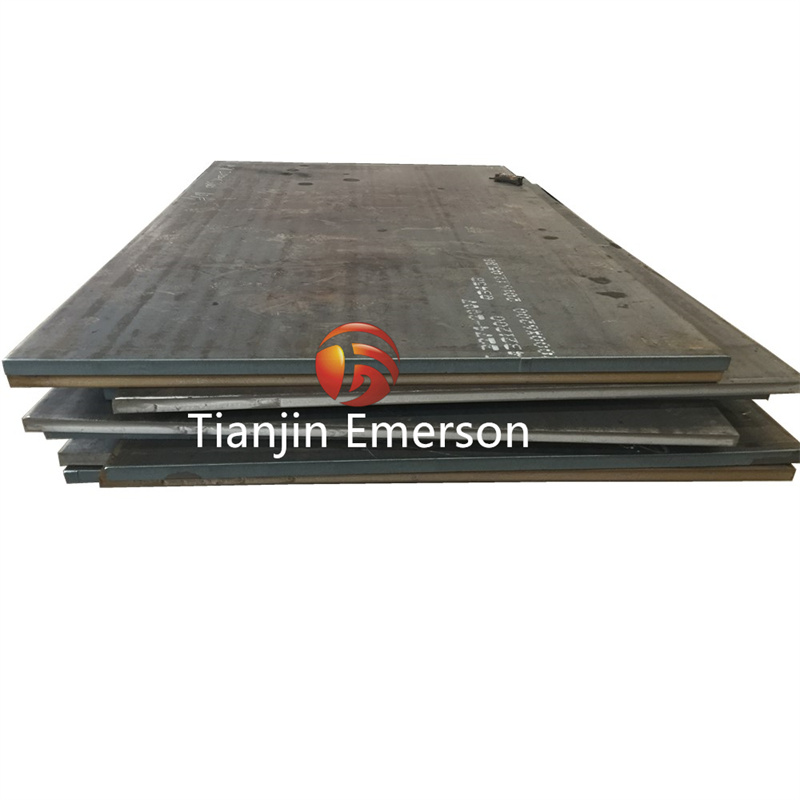
Evaluating Core Material Grades for Marine Fabrication
Selecting the right steel requires comparing yield strength, tensile strength, Charpy impact test temperatures, and application suitability. Understanding these dimensions allows engineers to specify the most efficient and compliant material for each section of the vessel. You do not need high-strength steel for every component.
Ordinary-Strength Grades
Ordinary-strength grades, classified as Grades A, B, D, and E, form the baseline for marine construction. These grades offer a minimum yield strength of 235 MPa. Shipyards typically use them for internal structures, deckhouses, and less critical hull sections where massive dynamic loads are not a primary concern.
The primary difference between these grades lies in their impact testing requirements. Grade A generally requires no impact testing, making it suitable for benign environments and internal components. Grade B undergoes testing at 0°C. Grade D requires testing at -20°C. Grade E requires rigorous testing at -40°C, ensuring reliability in freezing conditions and exposed deck areas.
Medium-Strength to High-Strength
High-strength grades handle intense structural loads. AH36 marine steel serves as the global industry standard for reducing overall vessel weight while maintaining exceptional structural integrity. Using high-strength steel allows naval architects to specify thinner plates, which reduces the lightship weight and increases cargo capacity.
These high-strength grades offer a minimum yield strength of 355 MPa. This is a significant jump from the 235 MPa of ordinary grades. The corresponding impact testing regimes match the ordinary grades: AH36 at 0°C, DH36 at -20°C, and EH36 at -40°C. This provides a clear matrix of strength and temperature resilience for the engineering team.
| Marine Steel Grade | Minimum Yield Strength | Charpy V-Notch Test Temperature | Common Usage Area |
| Grade A | 235 MPa | Not specified (or 20°C) | Superstructure, internal bulkheads |
| Grade D | 235 MPa | -20°C | Main deck plating, side shell |
| AH36 | 355 MPa | 0°C | Sheer strake, bilge strake, longitudinals |
| EH36 | 355 MPa | -40°C | Ice-breaking bows, exposed offshore structures |
Corrosion-Resistant and Specialized Alloys
Specific vessel areas require specialized plates. Cargo tanks, chemical tankers, and ice-class vessels demand materials tailored to their unique operational hazards. You might need enhanced corrosion resistance or extreme low-temperature toughness beyond standard carbon steel grades.
Modern fabrication often integrates non-ferrous metals like aluminum to reduce weight. Joining dissimilar metals requires explosion-welded bimetallic transition joints. These joints feature steel on one side and aluminum on the other. You weld the steel side to the steel deck and the aluminum side to the aluminum bulkhead. This prevents galvanic corrosion and ensures a structurally sound connection.
Application-Specific Selection Criteria
Mapping specific steel grades to their optimal use cases ensures structural efficiency and controls material costs. The operational demands of the final structure dictate the exact material specification required. You must match the steel to the environment.
Ship Hull Steel Plate Requirements
The hull acts as the vessel's primary structural envelope. The ship hull steel plate must possess high fatigue resistance and hydrodynamic stress tolerance. It must withstand continuous saltwater immersion, constant wave impact, and the dynamic flexing of the vessel while underway.
Naval architects typically specify high-strength grades for the sheer strake, bilge strake, and main deck. These areas experience the highest bending moments. Ordinary-strength grades often work well in the side shell and bottom plating of smaller vessels, depending on the longitudinal strength calculations.
Offshore Fabrication Steel
Offshore platforms, such as oil rigs and wind turbine foundations, face different challenges than traditional ships. The offshore fabrication steel must endure decades of stationary exposure to extreme weather, massive wave loads, and potential ice impacts. These structures cannot easily seek drydock for repairs.
These structures heavily rely on extreme low-temperature toughness. Furthermore, they often require Z-direction steel. Z-direction steel features documented through-thickness ductility properties. This specialized steel prevents lamellar tearing in highly constrained, thick-plate welded joints common in offshore tubular structures and heavy nodes.
Fabrication Realities: Shop Workflows, Cutting, and Welding
The transition from raw plate to a finished vessel involves a highly orchestrated sequence of fabrication steps. Efficiency and quality control during these stages determine whether the project makes money or loses money.
Modern Shipyard Fabrication Workflow
The modern workflow maximizes efficiency and minimizes field welding. The process follows a logical progression from raw material receipt to final erection on the slipway.
Receipt & Verification: The receiving team matches incoming plates to MTRs and checks flat tolerances to ensure material integrity before processing.
Nesting and Cutting: Programmers optimize plate yield using CNC plasma, oxy-fuel, or laser cutting systems to minimize scrap and ensure precise part dimensions.
Sub-assembly: Fitters weld stiffeners, brackets, and web frames onto flat plates to create stiffened panels on the shop floor.
Block/Module Assembly: Crews assemble 3D structural blocks inside the shop to maximize downhand welding and minimize out-of-position field welding.
Erection & Fit-up: Riggers transport completed blocks to the slipway or drydock for final alignment, tack welding, and structural connection to form the hull.
Weldability and Thermal Management
The carbon equivalent (CE) of high-strength marine steel directly impacts welding procedures. A higher CE increases the risk of brittleness in the heat-affected zone (HAZ). You must manage thermal inputs carefully to ensure weld integrity.
Proper procedures dictate pre-heating the steel, using matching filler metals, and employing low-hydrogen electrodes. Controlled cooling rates prevent hydrogen-induced cracking, especially in thick plates and highly constrained joints. If you weld thick EH36 plate in the middle of winter without pre-heating, the weld will crack.
Tack Welding and Field Fit-Up
Block erection on the slipway exposes the structure to fluctuating ambient shipyard temperatures. Proper tack welding sequences, temporary bracing, and strict fit-up tolerances maintain structural alignment and prevent distortion before final welding.
Improper fit-up forces welders to bridge large gaps. This introduces massive residual stresses into the hull. These stresses lead to premature fatigue cracking once the vessel enters service and encounters dynamic wave loads. Do not use hydraulic jacks to force poorly cut plates together; fix the cut.
Mitigating Cross-Contamination
Shop-floor best practices require strict separation of carbon steel fabrication from non-ferrous operations. You must isolate aluminum or stainless steel work from carbon steel grinding dust. Use dedicated tools, grinding wheels, and work areas.
Failing to isolate these materials leads to carbon contamination on stainless steel or severe galvanic corrosion issues with aluminum. This cross-contamination degrades the corrosion resistance and structural integrity of the non-ferrous components before the vessel even hits the water.
Procurement Trade-Offs and Supply Chain Risks
Sourcing shipbuilding steel plate involves balancing commercial realities with technical requirements. Procurement decisions directly impact project timelines and overall profitability. You cannot build a ship if the steel is stuck at the mill.
Sourcing specific certified thicknesses locally often proves challenging. Local suppliers offer faster delivery for common sizes, but specialized marine grades or unusual thicknesses require ordering directly from the mill. Mill orders extend lead times significantly. You must schedule your procurement months in advance to avoid fabrication delays.
Over-specifying materials inflates project budgets unnecessarily. High-strength steel is vital for the hull girder, but using it for non-critical bulkheads or internal superstructures wastes money. A thorough engineering review ensures ordinary-strength marine steel is used wherever it is sufficient and compliant. This optimizes the material budget without sacrificing safety.
Conclusion
Successful marine fabrication requires aligning material specifications with classification rules, operational environments, and shop-floor capabilities. Substituting certified marine plate with standard structural steel compromises safety and legality. Understanding the metallurgical properties, impact testing requirements, and fabrication realities of different steel grades ensures the structural integrity of your vessels.
To execute your next marine fabrication project correctly, take these immediate actions:
Review your structural drawings with a naval architect to confirm all specified steel grades meet the exact requirements of your chosen classification society.
Implement a mandatory receiving inspection protocol to verify heat numbers on physical plates against the provided Mill Test Reports before any cutting begins.
Audit your shop floor welding procedures to ensure your pre-heating parameters and filler metal selections match the carbon equivalent of the high-strength marine steel you plan to use.
Contact certified steel mills early in the bidding phase to secure accurate lead times for specialized thicknesses and avoid schedule delays.
FAQ
Q: Can I use standard ASTM A36 steel for ship repairs?
A: No. Standard A36 lacks the certified impact toughness and chemical refinement required by classification societies for marine environments. Using it for structural repairs without surveyor approval risks insurance denial and structural failure.
Q: What does the 'H' stand for in AH36 marine steel?
A: The 'H' designates it as a high-strength steel. AH36 has a minimum yield strength of 355 MPa, compared to the 235 MPa yield strength of ordinary-strength grades like Grade A.
Q: Why is Charpy V-Notch testing important for marine steel?
A: Charpy V-Notch testing measures the steel's ability to absorb energy and resist brittle fracture at specific temperatures. This ensures the hull will not crack under sudden dynamic wave impacts, especially in cold waters.
Q: What is a Mill Test Report (MTR) and why do I need it?
A: An MTR is a certified document from the steel mill detailing the chemical composition, mechanical properties, and heat number of the steel plate. It is legally required to prove the material meets classification society standards.
Q: How do I prevent galvanic corrosion when joining steel to aluminum?
A: You must use an explosion-welded bimetallic transition joint. This specialized insert allows you to weld steel to the steel side and aluminum to the aluminum side, preventing direct contact between the dissimilar metals.
Q: Does all shipbuilding steel require pre-heating before welding?
A: No. Pre-heating requirements depend on the steel's carbon equivalent, the plate thickness, and the ambient temperature. High-strength grades and thicker plates generally require pre-heating to prevent hydrogen-induced cracking.


